
Last Updated: November 20, 2026
Quick Summary
The best alternatives to coastal hotels on Great Ocean Road are inland cottages, boat houses, motor inns and rainforest retreats, which trade beachfront access for quieter nights and lower minimum-night risk. Inland and rainforest stays run about $220-$500 a night, often with free parking and kitchen access. Match each stay to a leg of the drive rather than booking every night in one town.
- Pick one base per leg of the drive and stay put to avoid backtracking.
- Three nights lets you drive the full route and actually stop.
- Inland and rainforest stays run $220-$500 a night with free off-street parking.
- Coastal hotels cost $250-$550 in peak season with high minimum-night risk.
- A two-night inland stay totals about $960 against $1,070 for a coastal hotel.
Table of Contents
- Why Look Beyond Coastal Hotels on the Great Ocean Road
- Great Ocean Road Towns to Stay In: Which Base Suits Your Trip
- How Many Nights on the Great Ocean Road Do You Actually Need?
- Great Ocean Road Itinerary and Accommodation: Matching Stays to Each Leg
- Rainforest Accommodation Great Ocean Road: Inland Stays Worth the Detour
- Coastal Hotels vs Alternative Stays: A Side-by-Side Comparison
- Comparing Costs, Seasonality and Availability Across Stay Types
- Planning a Rainforest Table at The Perch
- Frequently Asked Questions
Why Look Beyond Coastal Hotels on the Great Ocean Road
The best alternatives to coastal hotels on Great Ocean Road are the stays that trade a beachfront car park for something quieter: inland cottages, boat houses, motor inns and rainforest retreats. This guide covers which ones suit which trip, what they cost in trade-offs, and when a coastal hotel is genuinely the right call.
Here is the honest starting point most guides skip. The coastal strip between Torquay and Port Campbell is one of the most driven touring routes in the country, and its accommodation is priced accordingly. Parks Victoria’s visitor information for the Great Ocean Road region points travellers toward the same handful of towns, which funnels demand into a narrow band of rooms.
That funnel creates three problems: peak-season rates, thin availability for short stays, and a sameness to the rooms themselves. Inland and alternative stays can address all three, provided you know which trade-off you are accepting.
Great Ocean Road Towns to Stay In: Which Base Suits Your Trip
Choosing the right base matters more than choosing the right property. A well-chosen town makes the whole drive feel shorter.
- Torquay suits surfers and first-night arrivals, closest to Melbourne.
- Aireys Inlet is small, quiet and good for couples who want a village feel.
- Lorne has the most dining and the highest summer demand.
- Apollo Bay is the natural midpoint and the best base for a two-night stay.
- Port Campbell puts you closest to the Twelve Apostles for sunrise.
What most guides miss is that the drive time between these towns is not the issue. The issue is backtracking. Pick one base per leg and stay put.
How Many Nights on the Great Ocean Road Do You Actually Need?
The common mistake is treating the route as a day trip from Melbourne. It is not. Distances look short on a map, but the road bends constantly and every stop takes longer than planned.
A practical split:
- One night: Apollo Bay only, no western section
- Two nights: Apollo Bay plus Port Campbell
- Three nights: add a night inland or in Lorne
If you are driving the full route, three nights lets you actually stop.
Great Ocean Road Itinerary and Accommodation: Matching Stays to Each Leg
Match your accommodation to the leg, not to a single booking. This is the single biggest improvement you can make to a road trip itinerary.
Leg one, Melbourne to Apollo Bay. Stay in Torquay or Aireys Inlet. You want an easy first night, not a long drive after a flight.
Leg two, Apollo Bay to Port Campbell. Base yourself in Apollo Bay. It sits central to the Otways and the coast, so you can do both without moving.
Leg three, Port Campbell and inland. This is where an inland stay earns its place. Port Campbell accommodation fills fast around the Apostles, and an inland base gives you a quieter night and a shorter morning drive.
A common mistake is booking all nights in one town. You end up driving the same stretch twice.
Rainforest Accommodation Great Ocean Road: Inland Stays Worth the Detour
Inland stays are the most underrated option on this route, and they are where the Otways quietly outperform the coast. The hinterland behind Apollo Bay and Lavers Hill holds old-growth rainforest, tree ferns and walking trails that most coastal visitors never see.
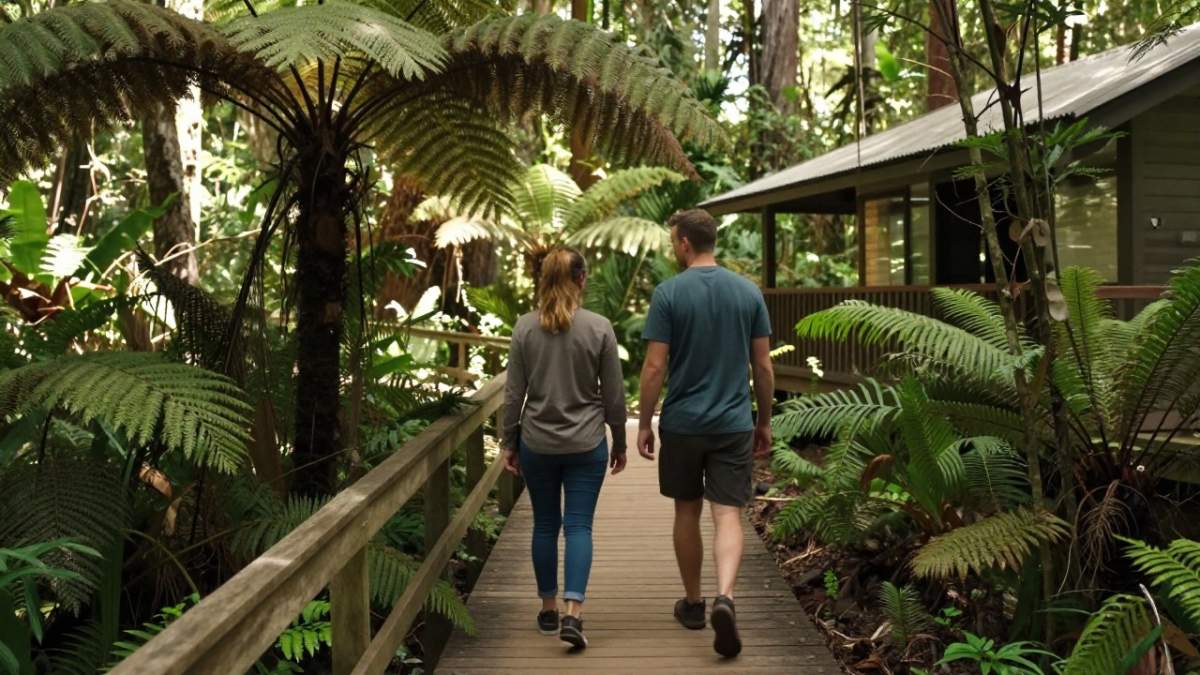
At The Perch, our gardens sit within old-growth rainforest with walking trails, native wildlife, and glow worms after dark.
You can see the local producers, growers and accommodation partners behind these inland stays on our partners page.
Coastal Hotels vs Alternative Stays: A Side-by-Side Comparison
The criteria that matter on this route are nightly rate band, minimum-night rules, parking, kitchen access, laundry, pet policy, late check-in and drive time to the nearest key stop.
| Stay type | Indicative nightly rate (AUD) | Minimum-night risk | Parking | Kitchen | Laundry | Pets | Late check-in | Drive to key stop |
|---|---|---|---|---|---|---|---|---|
| Coastal hotels | $250-$550 in peak; $180-$320 off-peak | High in January and long weekends | Usually paid or limited | Rarely | Usually yes | Rarely | Usually 24-hour reception | Walkable in Lorne and Apollo Bay |
| Motels and motor inns | $150-$280 | Low to moderate | Free, at door | Rarely | Sometimes | Sometimes | Often key-safe | 5-15 minutes |
| Self-contained cottages | $280-$650 | High; two- to three-night minimums common | Free, off-street | Yes | Yes | Often | Key-safe or host meet | 10-30 minutes |
| Boat houses and boutique stays | $350-$700 | Moderate; limited inventory | Free, off-street | Usually | Usually | Varies | Host meet | 5-20 minutes |
| Inland and rainforest stays | $220-$500 | Low to moderate | Free, off-street | Often | Often | Often | Host meet or key-safe | 20-40 minutes to coast |
These bands are indicative only and move with season, weekend demand and school holidays. Treat them as a starting point for comparing your dates, not as quoted rates.
Apollo Bay Waterfront Motor Inn is a straightforward motor-inn option in Apollo Bay, listed among Expedia’s Great Ocean Road accommodation choices. Sandpiper Motel Apollo Bay appears in a Tripadvisor roundup of lower-cost stays in the region, though the listing alone does not confirm it is cheaper for your dates. Rayville Boat Houses in Apollo Bay offers a genuinely different format, and Woodlands by the Sea in Port Campbell is a boutique alternative to a conventional hotel. Neither has published rates in the sources we reviewed.
What the table shows is that the comparison is not simply cheap versus expensive. A coastal hotel in Lorne in January can cost more per night than an inland cottage, and still leave you paying for parking and every meal. A motel looks cheapest until you add breakfast, lunch and dinner out for a family of four. A self-contained cottage looks expensive until you subtract the meals you cook and the second room you no longer need.
Best for: couples wanting a distinctive stay. Skip if: you need guaranteed on-site dining at short notice.
Comparing Costs, Seasonality and Availability Across Stay Types
A worked comparison for two nights, two adults. These are indicative figures in AUD, built from the rate bands above and common fee patterns, not quoted prices.
| Cost line | Coastal hotel | Motel | Self-contained cottage | Inland stay |
|---|---|---|---|---|
| Two nights’ accommodation | $700 | $420 | $760 | $620 |
| Parking | $30 | $0 | $0 | $0 |
| Breakfast (two mornings) | $80 | $50 | $0 (cooked in) | $0 (cooked in) |
| Other meals out | $260 | $300 | $180 | $220 |
| Cleaning fee | $0 | $0 | $120 | $80 |
| Fuel for extra driving | $0 | $0 | $0 | $40 |
| Indicative total | $1,070 | $770 | $1,060 | $960 |
Coastal hotel
Seasonality.
Availability and booking windows.
Fee mechanics to check before you compare.
For a deeper look at what is in season when you visit, see our Otways seasonal produce guide.
Planning a Rainforest Table at The Perch
The Perch is a restaurant and event venue on The Great Ocean Road, founded by hospitality veterans Dean and Gabrielle. Our menu is modern Australian, crafted from local ingredients and produce from our on-site kitchen gardens.
If you are planning a meal around your trip, read more about who we are, look through our menu, or get in touch to make a reservation.
Our versatile indoor and outdoor venues host weddings, corporate gatherings and celebrations, and custom menus are available.
The gap between a good Great Ocean Road trip and a forgettable one usually comes down to where you sleep, not what you see. If you want a stay that trades the beachfront car park for rainforest trails, kitchen-garden produce and native wildlife, The Perch offers tailored event planning, versatile indoor and outdoor spaces, and custom modern Australian menus built from local ingredients. Get started with The Perch and build your inland stay around a table worth driving for.
Frequently Asked Questions
What are the best alternatives to coastal hotels on the Great Ocean Road?
Cottages, self-contained apartments, eco retreats, caravan parks and motor inns all offer a different stay from a standard coastal hotel. Inland options near Lavers Hill and the Otways trade ocean views for rainforest and wildlife. Each type changes your nightly rate, parking, cooking facilities and how close you are to the Twelve Apostles and other attractions. Compare a few styles for your dates before booking.
Where should I stay on the Great Ocean Road if I want to avoid busy coastal towns?
Look inland to the Otways or to smaller hamlets between the main towns. Rainforest accommodation near Lavers Hill, for example, puts you among tree ferns and walking trails rather than summer crowds. You still reach the coast in under an hour for day trips. Book early for peak periods, because inland properties have fewer rooms than the big coastal hotels.
Are there rainforest stays near the Great Ocean Road?
Yes. The Otways hinterland, around Lavers Hill and Beech Forest, has cottages, eco retreats and guesthouses set in old-growth forest. Many are self-contained and dog-friendly, and some sit close to walking trails and glow worm sites. Check each property’s amenities and cancellation terms directly, because facilities vary and availability changes with the season.
Is it better to stay in one place or move between towns on the Great Ocean Road?
One base suits short trips of two or three nights, because you spend less time packing and driving. Moving between towns works better over four or more nights, letting you split the route into western and eastern halves. A common approach is two nights near Apollo Bay or the Otways, then one or two nights closer to Port Campbell for the Twelve Apostles.
What should I look for when choosing accommodation away from the coast?
Check driving times to the attractions you want to see, whether the property is self-contained, and what parking is available. Confirm mobile coverage, heating and cancellation policies, especially in winter. If you plan to eat out, ask about nearby dining and whether you need to book ahead. Pet owners should confirm whether dogs are allowed inside or only in designated areas.
