
Table of Contents
- What the Average Wedding Venue Cost Actually Covers in 2026
- A Wedding Venue Hire Inclusions Checklist
- Hidden Costs in Wedding Venue Contracts Couples Miss
- Is a Rainforest Wedding Venue Worth the Extra Cost?
- How Season, Guest Count and Day of the Week Move the Price
- Insurance, Sustainability and DIY: Costs Most Guides Skip
- Conclusion
- Frequently Asked Questions
Last Updated: September 11, 2026
What the Average Wedding Venue Cost Actually Covers in 2026
Working out what a wedding venue cost breakdown 2026 includes is the first step to avoiding a nasty surprise six months out. The headline hire fee is rarely the final invoice. A wedding venue cost is a stack of separate charges bundled into one quote, and knowing which layer sits where separates a smooth budget from a stressful one.
The core costs inside a venue hire fee
A venue hire fee is the base charge for exclusive use of the space for a set window. It typically covers the room or grounds, tables and chairs, basic lighting, and setup and pack-down staff. Everything else, from food to flowers, sits on top. Most venues quote it separately from catering because it’s the easiest number to compare across properties, and the easiest to underestimate once extras land.
Where the money goes: a typical split
Catering and beverages usually account for the largest share of any reception budget, followed by the hire fee, then styling, photography, and entertainment. Guest count drives most of that variation: per-head catering scales with your list, while the hire fee stays fixed. That distinction explains why trimming ten guests often saves more than switching venues.
| Budget Line | What It Covers | Scales With Guest Count? |
|---|---|---|
| Venue hire fee | Exclusive use, furniture, basic setup | No |
| Per-head catering | Food service per guest | Yes |
| Beverage package | Drinks, bar tab, staff | Yes |
| Ceremony fee | Separate ceremony space | Sometimes |
| Styling and florals | Decor, installations | No |
| Photography and entertainment | Vendors, travel | No |
A Wedding Venue Hire Inclusions Checklist
An inclusions list is only useful if you can price what’s missing from it. A good list names every item the venue provides in writing, so you can attach a realistic cost to each gap before you sign. If it isn’t listed, assume you’re paying separately, and that the quote is the floor, not the ceiling.
The fastest way to compare two venues is to convert inclusions into a like-for-like number: take the hire fee, add the market cost of anything the venue doesn’t provide, and compare totals. A venue quoting a higher hire fee but including tables, linen, staffing, and a wet-weather space often lands cheaper than a low-fee venue where you hire everything in.
What to check, and what each gap typically costs you
- Exclusive use for a defined time window, confirm the exact start and finish, and whether bump-in and bump-out sit inside or outside that window. Overtime is usually charged hourly.
- Tables, chairs, and basic linen, if excluded, expect separate hire, delivery, and collection charges, plus a damage waiver.
- Ceremony space, if you’re marrying on site, some venues charge a separate ceremony fee even when you’re holding the reception there.
- Kitchen access or in-house catering arrangements, if the venue is BYO caterer, check whether kitchen use, refrigeration, and power are included or charged as a facility fee.
- Bar service and beverage package options, ask whether you can run a tab, a consumption bar, or a capped package, and whether corkage applies if you supply your own wine.
- Setup and pack-down labour, confirm who moves furniture, who clears tables, and whether a cleaning fee applies at the end.
- On-site event coordinator for the day, a venue coordinator manages the building, not your run sheet. If you need someone to run the timeline, that is a separate planner cost.
- Parking and guest access arrangements, remote venues may need shuttle buses, and that is a line item most couples forget until the RSVPs arrive.
- Wet-weather contingency space, for outdoor ceremonies, confirm whether a backup space is included or hired at extra cost, and by what date you must decide.
- Vendor requirements and approved supplier list, some venues require you to use their caterer, florist, or AV supplier, which removes your ability to negotiate those costs down.
- Public liability insurance, check whether the venue’s policy covers your event or whether you must take out your own cover.
- Audio-visual and power, microphones, speakers, staging, and generator hire are frequently excluded from outdoor and blank-canvas venues.
Ask for the inclusions list as a written schedule, not a verbal rundown. Venues that hand over a clear document tend to have fewer disputes later, and you can compare two quotes line by line instead of guessing. Where an item is excluded, ask the venue for their recommended supplier; the price they quote is usually closer to reality than a generic online estimate.
Turning inclusions into a comparable number
Once you have both lists, score each venue on four columns: hire fee, per-head catering, inclusions you’d otherwise pay for, and exclusions you must fund yourself. The venue with the lower hire fee frequently loses on the fourth column. It converts a marketing document into a number you can defend.
Hidden Costs in Wedding Venue Contracts Couples Miss
Hidden costs in wedding venue contracts are the line items buried in the fine print: service charges, public holiday surcharges, security deposits, and vendor meals. None are dishonest, but all add up. A service charge is a percentage added to your food and beverage total, separate from gratuities. Vendor meals cover the photographers, band, and planner who work through dinner, charged per head.
Then there’s the security deposit, usually refundable but held against damage or overtime, and the cancellation policy, which determines how much you lose if plans change. Weekend and public holiday surcharges lift the base rate noticeably, and a bar tab that runs dry mid-reception is a cost nobody budgets for until it happens.
Questions to ask before you sign
- What is the total minimum spend, and does the hire fee count toward it?
- Which charges sit outside the quoted price: service charge, surcharges, deposits?
- What is the cancellation and date-change policy, in writing?
- How many vendor meals are included, and what do extra ones cost?
- Is there a noise curfew or overtime fee?
Is a Rainforest Wedding Venue Worth the Extra Cost?
For couples who want the setting to do the heavy lifting on atmosphere, a rainforest wedding venue is often worth the extra cost because it removes the need for elaborate styling. It’s a common question, and the answer depends on what you’re comparing it to. A blank-canvas space looks cheaper on paper until you add hire costs for every table, chair, light, and floral installation.
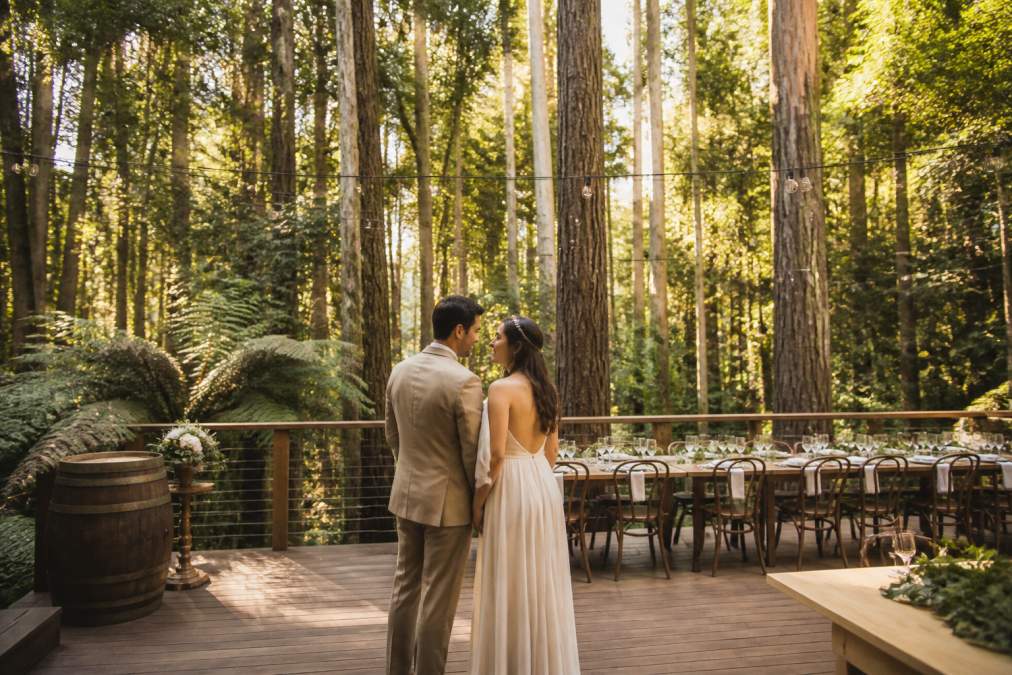
A rainforest setting arrives already styled. Old-growth trees, native gardens, and resident wildlife replace the florist’s budget, and photographs need no backdrop. The trade-off is logistics: guest travel, wet-weather contingency, and fewer nearby vendors. If your guest list is mostly local and you value experience over a ballroom, the maths usually favours the rainforest. If you need city-hotel convenience, it won’t.
The real comparison isn’t rainforest versus ballroom on hire fee alone. It’s total styling spend, travel logistics, and how much of the atmosphere you have to build versus inherit.
How Season, Guest Count and Day of the Week Move the Price
Three variables move a venue quote more than anything else: peak season, guest count, and day of the week. Peak season pricing reflects demand; venues charge more when dates are scarce. Off-peak discounts are real, and largest in the cooler months and mid-week. wedding venue options.
Day of the week matters just as much. A Saturday in peak season sits at the top of the range; a Friday or Sunday drops it, and mid-week drops it further. Guest count then multiplies everything that scales per head, from catering to beverage packages. Fix your guest count first, then choose a date that trades peak for off-peak without compromising the season you want.
Booking a peak-season Saturday before locking in your guest count is a common budgeting mistake. The per-head costs can then exceed estimates, leaving no flexibility in the date to recover it.
Insurance, Sustainability and DIY: Costs Most Guides Skip
Three cost areas sit outside almost every standard breakdown, and each can shift your budget meaningfully. Most guides skip them because they’re hard to quote, precisely why they’re worth pricing properly.
Venue insurance and liability
Many venues require couples to hold public liability cover, and if your venue doesn’t include it, that’s a separate premium. It typically protects against guest injury or property damage during your hire period. Check three things before assuming you’re protected: whether the venue’s policy extends to your event, what excess applies to a claim, and whether your suppliers carry their own cover; an uninsured supplier can leave you exposed if equipment damages the venue. For a private property or marquee, you’ll usually need your own policy, with premiums scaling by guest numbers and whether alcohol is served.
Sustainability and what it does to the price
Venues with on-site kitchen gardens, local produce, and responsible waste management often build those practices into pricing, but they also cut costs elsewhere: fewer flowers flown in, less single-use waste, and seasonal menus. A seasonal menu sourced nearby is cheaper to produce than an out-of-season one flown in, and the saving is often passed through as a lower per-head rate. Where sustainability costs more is the fit-out: reusable crockery, glassware, and linen carry higher upfront hire than disposables, and composting or recycling systems can add a facility charge. For couples who care about the footprint, the alignment is part of the value, but it isn’t automatically cheaper. Ask the venue which practices are included in the per-head rate and which are charged separately.
DIY versus all-inclusive: the actual maths
Hiring a private property or marquee and building the event yourself can look cheaper, but the gap narrows fast once you price the full list. A blank-canvas hire typically excludes:
- Furniture, linen, and tableware hire, plus delivery and collection
- Portable toilets or additional bathroom facilities
- Generator hire and power distribution
- Lighting, sound, and staging
- Marquee, flooring, and heating or cooling
- Public liability insurance
- Cleaning, rubbish removal, and site restoration
- A coordinator to run the day
- Staff for setup, service, and pack-down
Add those to the hire fee and the DIY total frequently lands within range of an all-inclusive venue, sometimes above it, once you count the hours sourcing and managing suppliers. DIY wins when you have time, a reliable vendor network, and a tolerance for risk. It rarely wins as a pure cost-saving play.
| Approach | Upfront Cost | Hidden Effort | Best For |
|---|---|---|---|
| All-inclusive venue | Higher, predictable | Low | Couples wanting one coordinator |
| Rainforest venue | Mid to high | Low to mid | Atmosphere-led celebrations |
| DIY property hire | Lower on paper | Very high | Hands-on planners with vendor contacts |
The DIY comparison only works if you price every excluded item before you commit. Couples who compare a blank-canvas hire fee against an all-inclusive per-head rate are comparing two different things, and the shortfall usually appears in the final month when there is no room left to absorb it.
Couples who want the setting, catering, and coordination handled by one team, with room to customise the menu around dietary requirements rather than being locked to a set list.
Conclusion
Building a wedding venue cost breakdown 2026 that holds up means pricing the whole event, not just the hire fee. Couples who stay on budget ask for inclusions in writing, budget for service charges and vendor meals from day one, and choose a date that works with their guest count rather than against it.
Set among old-growth rainforest with on-site kitchen gardens, resident wildlife, and custom menus built around modern Australian produce, The Perch handles tailored event planning and seamless coordination, including vendor recommendations, so the logistics sit with the venue rather than on your spreadsheet. For couples who want the setting to carry the atmosphere and the catering to be memorable, it offers a unique experience.
Reserve Now with The Perch and plan a celebration where the rainforest does half the work.
Frequently Asked Questions
How much does the average Australian wedding cost in 2026?
National averages sit in the tens of thousands of dollars once venue hire, catering, photography, attire and styling are added together, and the venue is usually the single largest line item. What you actually pay depends on guest count, season, day of the week and how much the venue includes. Rather than anchoring to a national figure, build your budget from real quotes for the specific venues you are considering, then add a buffer for the extras that always appear.
What should be included in a standard wedding venue hire fee?
A solid hire fee normally covers exclusive use of the space for a set number of hours, tables, chairs, basic glassware and cutlery, staff to set up and pack down, and access to a kitchen or catering team. Ask specifically about ceremony fees, cake cutting, vendor meals, security, cleaning and overtime rates. The wedding venue hire inclusions checklist in this guide walks through each item so you can compare quotes on equal terms instead of guessing.
What hidden costs in wedding venue contracts should I watch for?
The common ones are public holiday surcharges, service charges on food and beverage, corkage if you supply your own wine, extended-hour fees, security guard requirements, and a minimum spend that applies even if your guest count drops. Cancellation and postponement clauses matter too. Read the contract line by line, ask for a written total for your exact date and guest numbers, and confirm which figures are fixed versus estimated.
How do seasonal price variations affect 2026 wedding venue costs?
Peak season dates, typically spring and early autumn weekends, carry the highest venue hire fees and minimum spends. Off-peak discounts are common in winter and on Fridays, Sundays and weekdays. Choosing an off-peak date can reduce the venue line of your wedding budget noticeably, and it often means more flexibility on menu choices and styling. Ask each venue for both their peak and off-peak rates before you commit to a date.
Is a rainforest wedding venue worth the extra cost?
It depends on what you value. A rainforest setting usually means you spend less on styling, because the backdrop does the work, and more on wet-weather contingency and transport for guests. If you want a ceremony that feels genuinely different and you are comfortable with a plan B for rain, the premium is often offset by savings elsewhere. Visit in the season you plan to marry and ask how the space works indoors if it pours.
Is a $10,000 wedding budget realistic for a venue-inclusive package?
It is tight but not impossible for a small guest list, an off-peak date and a venue that bundles hire, catering and basic styling into one fee. The pressure point is per-head catering, which scales quickly with guest numbers. A 20-person midweek celebration is far more achievable at that budget than a 100-person Saturday event. Ask venues directly what they can deliver at your figure rather than assuming the answer is no.